Sunday, October 23, 2011

Spinning Tales of Dancing Deities: Thimphu Tsechu and the Royal Wedding

It’s almost three months since we arrived in Bhutan, and Thimphu has been abuzz with the yearly Tshechu festival and the most exciting event in town since the coronation of the fifth king—the royal wedding. The Tsechu, which happened in late September in Thimphu, is an annual festival that each Dzongkhag (district) holds at their respective dzongs (fortresses.) During the festival the lamas (monks) perform masked dances that are meant to purify the people watching them of their defilements. The dances retell the stories of Guru Rimpoche, Drukpa Kinley (the divine madman), and other important Bhutanese Buddhist figures. The lamas dress as saints and deities and dance to Kadrukpa music (the music perfomed by only monastics.) We were fortunate to be able to see a Tshechu performance in Bumthang (about 12 hours’ drive from Thimphu) the previous weekend. When we returned I went with my friends to the final day of Tsechu in Thimphu. The town was incredibly busy and there was so little traffic coming to RTC that we walked two miles down the hill (I was in fancy dress and a pair of not-hiking friendly high heels…ouch!) to catch a taxi.
The Dzong’s large courtyard was completely packed with the most colorful audience I have ever seen. Bright silk tops and woven kira that take can take years to make and brilliantly colored fancy gho covered by the white sashes—kabne—worn by men on formal occasions and brightly embroidered ratchu (scarves worn by women for formal events) made the auditorium look beautifully decorated by the people themselves. On the upper balcony sat the Je Khempo—head of the monastic body—wearing sunglasses and a bright yellow kabne. The lamas came out dressed in elaborate costumes, some wearing the terrifying masks of the demons. They spun in circles at the center of the courtyard, each twirl revealing another layer of bright fabric underneath their skirts. My friend offered to take me to receive a blessing from the lamas, so I went with her to venture in to the rainbow crowd. It took us one hour to get to the line to be blessed, the entire time being relentlessly pushed by the crowds eager to be blessed. Finally we reached a lama sitting on a chair with an umbrella over him wearing a golden Guru Rinpoche mask and holding a golden rod with a tassel on the end. We were quickly pushed through the line of lamas and bending down and covering our mouths with our ratchus to keep from breathing on the lamas, we were tapped on the head with the tassel and pushed through the line of lamas to receive blessed cords to tie on our necks and a tiny little seed that I was supposed to eat. I couldn’t find an explanation of what it was from anyone except that it was blessed. After standing outside for a number of hours we made our way back in to town where the colorful audience had begun to disperse and paint the streets of Thimphu.

A couple of weeks later was the royal wedding of King Jigme Khesar Namgyal Wangchuck to Ashi Jetsun Pema. Thimphu eagerly prepared for the wedding—covering every building in the main town with long strands of bright lights, every main road entry with painted archways with illustrations of mystical creatures and dieties, and huge posters of the King and Queen wishing them tashi delek—good luck! Everyone donned pins with pictures of the royal couple and stores offered discounts to celebrate the wedding. In the main clock tower square a stage and stalls were set up selling food and handicrafts. Children and teenagers ran to the game stalls to play carnival games and families, lamas, and tourists flocked to the steps in front of the stage to watch the groups of dancers perform to well-loved Dzongkha songs. The lyrics varied from romantic: “in my garden your heart is the only flower”, “beautiful girl, beautiful girl, who is that girl?” to nationalistic: “protect the beautiful environment of Bhutan, the land blessed by mountains and the glorious Wangchuck dynasty.”

The royal couple was married in a relatively intimate and elaborate ceremony in Punakha (the gates of the city were closed to any who did not have tickets for the wedding) and the next day the King and newly crowned Queen began the journey to Thimphu and stopped all along the way to walk and greet their subjects. Driving into town that day crammed in to the back of one of the last taxis in the city, I was in awe to see the entire express highway leading all the way to the town lined with people wanting to see the newlyweds and offer their best wishes. Some had been waiting for five hours outside and when we came by in the taxi many stood up eagerly waving their flags the sat down again once they saw we were not the royal caravan approaching. Most shops were closed down and everyone was outside in the streets waiting for the king to arrive. Since there was little ability to move in the city, I sat down and waited for two hours. By the time I had to leave to meet my friend at her uncle’s weaving shop, the royal couple had not yet arrived. I had to pay triple for a taxi to take me to the weaving center, the driver even walking me part of the way because most roads were completely shut down in anticipation of the King and Queen’s arrival. Celebrations continued on to the next day and by the end of the weekend a slight sloth and torpor seemed to settle over the city as everyone settled back and began to practice the stories they would tell about the royal wedding through the upcoming winter and for years to come.

Nurit
Majors in Anthropology and Asian Studies
Class of 2014

For more blog posts see http://lettersfrombhutan.tumblr.com/ and photo posts http://nurit.tumblr.com
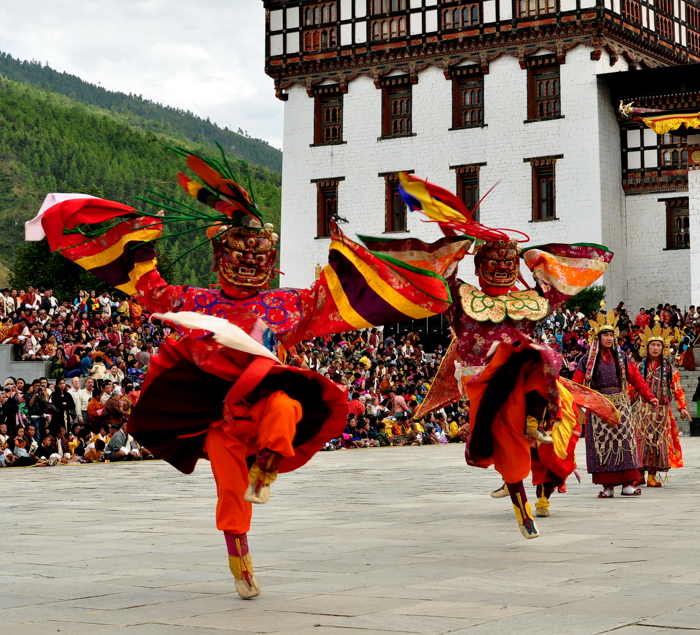

Masked dance, Thimphu Tsechu.

At Thimphu Tsechu with two deaf students from Drak Tsho where I do part of my internship work.

Crowds wait to see the royal couple. Thimphu town.

Saturday, October 22, 2011

E Z like Sunday Mornin

I pull the covers closer to my body and peer over at the clock on my phone – 8:06 it reads... I must have drifted back to sleep because when I look again a moment later it is 8:21. I stretch my hands above my head and make my way out of bed, the cold hits me. I throw my sweat pants on over my pajamas, a sweatshirt over my T-shirt, a jacket, winter hat, and mittens. I love the way the air feels on my face when I walk outside... I have always enjoyed Sundays, Sunday mornings in particular. I'm not sure why but they just feel unlike any other morning in the week... The snow capped mountains appear chiseled out of the Himalayan sky as I exit my hostel and make my way to the dining hall – Breakfast at RTC closes at 9 AM, this kick starts my morning a bit earlier than at Wheaton; I like it. The breakfast Monday through Saturday is fried rice (I've become a big fan and am not sure if I'll be able to transition back to eggs) but on Sunday they like to mix it up – today it is some kind of stew with dough and vegetables; it warms my body right up. I bump into my friend Jigme on the way out of the dining hall, he tells me he is on his way to officiate a cricket match, I go along to watch. I like cricket, I never understood the game until about a month ago when my friends here explained it to me... The sun has traveled above the mountains and is beating down on the cricket pitch. I walk to a field on the lower end of campus and lay down in the grass. There's no more need for the layers I put on a few hours ago in my cold room. The sun warms my skin, I'm back in my pajamas and T-shirt. I close my eyes and feel the breeze.


-Billy

Friday, October 21, 2011

Reflections from August--the Conference on Happiness and Economic Development

AUGUST 21

Earlier this month the Wheaton group attended the Conference on Happiness and Economics in Bhutan. The conference centered around the concept and method of measuring well-being in relation to economic development. As you may know, Bhutan's unique form of measuring development, Gross National Happiness (GNH), is quickly gaining popularity around the world. The main thrust and logic behind GNH is that every society is striving to increase happiness... So why not measure progress in terms of happiness? GNH motivates individuals and governments to foster the conditions for society to maximize the happiness of its members. Prominent members at the conference were His Excellency and Prime Minister of Bhutan Jigme Y Thinley, economist Jeffery Sachs, philosopher Peter Singer, head of the Center for Bhutan Studies, Dasho Karma Ura, and many more international academics and community visionaries.

Since GNH has become popular, communities around the world have been striving to define what they consider happiness and well-being, and then find their own ways to maximize it. The Conference provided a forum for discussion on different movements and their quest for well-being, as well as academic analyses of the relationship between economics and well-being.
Some lessons emerged: individuals with a sense of agency (or empowerment) are happier than those who aren't; agency combined with capability (captured by Amartya Sen's capabilities approach) yields greater happiness; happiness is inclusive of all people and reaches into the physical and psychological domains; altruism is essential to individual and social transformation; income alone does not contribute to happiness...

I found that most interesting, aside from these findings, were some of the perspectives and questions posed. John Wiseman asked: what are the spiritual, emotional and cultural needs of society, as well as its material needs? And how do we achieve a balance between the two? Ultimately, Wiseman contended, a measure of development should support citizen engagement in the public domain and in policy making. GNH was later put in Bhutanese context: "happiness is our goal and philosophy, and economic development is the path we must take."

The head of Bhutan's monastic body discussed the importance of wisdom in attaining happiness. Temporary happiness is caused by emotion or impulse, while long term happiness results from inner wisdom and revealing the Buddha nature that lies within each sentient being. The way to happiness can be taught, as Buddhism strives to do by teaching the study the mind and human nature. It is the eight-fold path that provides the framework to a life of happiness. Most important is the practice of meditation and developing mindfulness. Without these wisdom is fleeting and happiness evasive. We, like the Buddha himself, must become buddha to help others reach the same destination: happiness.
Jeffery Sachs made the concluding remarks. He discussed the many approaches to happiness, emphasizing that the Buddhist approach begins from within and leads to social, political and economic change. Context is essential to understanding any approach. In this respect, Sachs asserted, we are experiencing the crisis of modernity: urban life is much more complex and stressful than the traditional life, which is excelled by rapid economic development and industrialization. Coupled with this is the crisis of spirituality, which is observable in the destruction of our natural environment. The problem, says Sachs, is that that there is a separation of the individual from the environment which is exacerbated by urbanization.

These reflections are hardly new, but serve to put GNH in perspective of Bhutan's development. Thimphu, the capital of Bhutan, is growing rapidly and is a case study of rapid development/urbanization. In the past, Bhutan's society and economy was focused on rural life, consisting of farming and tending to livestock. Now, most youth and many adults are attracted to the benefits of the urban life: service and business based jobs (as compared with the rural hard labor), more opportunities for employment and social mobility, higher incomes and their associated benefits (technology, cars, fashion, etc). In short, living in the city seems to be more rewarding and desirable than living in the country.

The youth is quite fond of Western music, style and behavior. Accompanying rapid urbanization are social problems such as alcoholism, tobacco and substance addictions, poverty, untreated waste and environmental destruction. Traditional Buddhist and Bhutanese values are naturally eroding and transforming. In this respect,GNH is much more than a measurement of development, but also a tool for social change. The four pillars of GNH are environmental conservation, good governance, preservation and promotion of cultural values, and sustainable development. One could see how GNH could be a response to the problems facing Bhutan, discussed above and embodied in the effects of globalization. Emerging from this conversation is a focus on value-education, through which the youth and future of Bhutan will harbor Buddhist and Bhutanese values, including: social responsibility, respect for self and other, compassion, environmental sensitivity, and so forth.

I finish here with recommendations made by Jeffery Sachs to advance global GNH: 1) document conference proceedings to expose greater population to discussion, 2) create a World Happiness/ economic forum to include main actors of globalization in this conversation, 3) co-host a UN meeting in the spring for a global meeting on happiness, to be summarized in a UN report, 4) reach across organization, suggesting that governments set own goals and use their own measurements for well-being progress, and 5) make recommendations for policy making and GNH implementations, using lessons from own experiences.

Tuesday, September 20, 2011

Señales y Sonrisas, Signs and Smiles


Smiles, dancing, laughters and sign language from the Drakso School is what made me feel like I found a place where I want to spend some of my afternoons. I just started attending on Wed. and Fri. Drakso School, which is a vocational school for people with disabilities.They do amazingly creative and beautiful things there. They teach students how to paint, weave, carve and be fluent in sign language.
On my first day I sat next to a youn man who was painting the eight auspicious signs. He did every sign which such care and precision that it was just mind blowing. That same afternoon we all went to the patio and danced with them a Bhutanese song they are practicing for the Special Olympics event and we then also danced to modern music and we attempted to do some break dance ( and to be honest they were by far much better than I was).
Last Friday I went by myself. As soon as I came into the school a little boy rushed me to one of the rooms and started pointing at different images and doing the equivalent of them in sign language. We must have been there for at least half and hour and he taught me about 20 different signs, from signing toy box to stove.
 On that same day I had decided to take my camera with me and to my suprise all the students were very intrested in my taking pictures and videos of them. We basically had a photoshoot with them and just seeing how happy and comfortable they were about my presence there made my day. After it was time for all to leave I went down into town with three of the guys from the school and we sat in a cafe and had tea and momos ( dumplings). Two monks walked into the cafe and suddenly my friend got super excited and signaled me the sign for monk ( which is a combination of red + prayer). I learned so much  about them through that experience and I felt so lucky to be there with them. It is on days like these that it seems surreal that I am in Bhutan.
These  pictures are from rom that amazing day.


by : Marijose Vilá 2013

Monday, September 19, 2011

Vishwakarma Puja

This past Saturday as I was walking in RTC I noticed a car that was decorated with balloons and colorful ribbons all over it. At first I didn't think much of it, I thought that maybe someone had a birthday and the car had been decorated by friends. When a few minutes later I noticed that people were decorating motorcycles and other cars,I knew something different was going on.... but what? I asked my roommate and she told me that Sept 17 and 18 Vishwakarma Puja is celebrated by Hindus in Bhutan


Vishwakarma is regarded as the God of technology, architecture and engineering. In fact as a son  of Brahma, he considered to be the divine draftsman of the whole universe, and the official builder of all the gods' palaces. Vishwakarma is also the designer of all the flying chariots of the gods, and all their weapons. My roommate even told me that I should be thankful for the existence of laptops to him. I decided to take a bus into town and see for myself how this was being celebrated. As the bus starts descending into town I notice that in auto shops and constructions sites, colorful shrines are being built and the statue or image of Vishwakarma is being venerated by workers dancing and chanting ! What a view ! Offerings of food and money were being made and of course once we reach  the city bus stop I noticed that they had their own shrine as well.On the highway other cars, taxis and buses were also decorated and people were honking as they passed us.

The next day I went into town and I thought that by now the celebrations would be over, but little did I know it is a 2 days celebration. As I was standing on the street a construction bus rushed by with workers on  the back dancing, drinking and singing ( they even carried palm trees on the back of the bus with them). They were also carrying the statue of Vishwakarma. I saw a couple of more buses heading towards the same direction, and it turns out that the celebration culminated in the river bank where the Vishwakarma is thrown into the river and washed away. It was hard for me to understand why an image that was venerated was being thrown into the river after the festivities were over. What does that symbolize ? That I still don't know.
 Amazing.


Marijose Vila 2013 ( pics by me ) 

Friday, September 9, 2011

Am I in a dream?

By Nurit A.

By Nurit A.

I wake up, look out the window and think "is this real?" I have this desire to take you all on this special journey with me. It almost  feels too overwhelming to tell you everything because I am afraid of not being able to express it right. As Adam was saying the other day, “not even the pictures can show the exactness of the beauty of this place.” Now that I feel like I am truly part of Bhutan, that I am living my life here, I think I can start sharing with you what it has been like.
I have travelled to many places in my life, but I have never encountered such a magical place. My ears are wide open; everyone here has something to teach us. Just this morning as a friend of mine, Kinga, woke me up at 5:30 am to practice for the marathon; we saw sunflowers and she asked me “Do you eat sunflower seeds in your country?” I told her we did, and that it was delicious when it was grilled with salt. I asked her if they ate the seeds here and she said “no, it is considered a sin because it is said that if you eat one seed it is as if you were killing 500 monks.”  There are so many beliefs; so many sayings and each teach us about what it means to be human and to be part of this world while respecting the environment we live in. She also told me that Bhutanese are taught not to eat honey because each bee puts in so much work in making it, that it would be considered as stealing to take it. While we were running, she kept on stopping in the middle of the road in order to move the caterpillars back onto the grass so that people would not step on them. After our run we went to her room to have some green tea. While the water was boiling she sat crossed legged and started her morning prayer. Then she opened her eyes and asked me if I wanted to join her in meditating. I gladly accepted and we meditated facing the window overlooking the mountains.
Being surrounded by nature makes all the difference in my life. It invites me to find my inner peace in such a natural manner. Its so easy to forget that there is a whole other world that exists outside of Bhutan. I think its because I have been so concentrated on my life here. Every day feels like weeks because so much is going on. We are lucky to be surrounded by a forest and a  river. This gives us the opportunity to escape into the wilderness for some alone time. "I feel like a fairy," is what Ellie said the last time we went for a walk near the river. She's right, so many times I have felt like we were part of this fairy tale where anything could happen and it would feel completely normal. But this is real life, and yet I still can't get used to it.  
By Adam Goldberg

Ludivine de Rancourt (class 2013)

Monday, September 5, 2011

Day 36, still going strong...

This is Aaron writing again; it feels both like much more and much less than a month we have been here, and I am speaking for more than just myself when I say we have been much busier than we anticipated prior to arriving.  Between our studies, internships, independent lives at RTC, group responsibilities (ranging from numerous dinner invitations to practicing a traditional Bhutanese dance for a show for the Royal Thimphu College student body), many days we are quite literally occupied from waking up until going to bed.

Last weekend the group went on a trek, which I hope someone else can comment on; I stayed back because I was sick, and spent the weekend reading, watching movies, and recovering.  I enjoyed my time by myself about as much as you can enjoy being sick alone for a weekend (which I do not mean sarcastically--I actually very much enjoyed the alone time--but I was still sick).

It has also been an adventure to have what I call a very "21st century experience" in Bhutan, made so not just by the timing of our experience here in relation to Bhutan's history and development but also because technology is making all corners of the world much more connected.  I often laugh to myself when I think of if Lewis and Clark, or Christopher Columbus, or insert-your-own had access to digital cameras, skype, Facebook, cell phones and text messages.  As I learned when I tried to resist it a few years ago in South Africa (the first time I was living independent internationally), it just is not possible to have an experience  anywhere in today's world without friends and family from all other parts of the world being able to maintain contact with you.  I'm not yet fully sure what this means for the future of the world, but I have no doubt it will continue to bring profound changes in the way people interact with and understand one another.

I think the same thing every time I see a reminder of how truly interconnected the world is here--I have two favorites tied for first place from our time in Bhutan so far.  The first was when we were in a welcoming ceremony of Royal Thimphu College, where the college director (who holds the rank of Dasho in Bhutanese society, which denotes royalty) was giving his opening speech.  All the students--including the eleven of us from Wheaton--were wearing the national dress, kira for women and gho for men.  The Dasho's speech focused on Bhutanese tradition, modernity, and now democracy and preparing for embracing it all through acquiring a college education.  At no less than three points, students' cell phones went off--once with a ring tone of "What's My Name" by Rihanna (an international pop hit), and another ring tone playing Enrique Iglasias.

The other was when we had the good fortune to attend an international conference on "Gross National Happiness and Economic Development", co-chaired by Jeffrey Sachs and the Prime Minister of Bhutan.  As Jeffrey Sachs summarized the outcomes of the conference , a high-ranking Buddhist Lama sitting on the inner panel of VIP's, (who had just a few hours earlier spoken of the importance of spiritual edification alongside economic development) started scrolling through his messages on his BlackBerry.  I don't know for sure, but I like to imagine he was also checking his Facebook, all while Jeffrey Sachs exalted the leadership of Bhutan's Kings in bringing happiness to global political attention.

The 21st century really is--and every day only more so--a radically different world from what has come before it, and it is amazing how much of this is brought about by things like cell phones and Facebook.  It's the little things that remind me of this in Bhutan, a country which has a unique relationship to the changes taking place in all corners of today's world.